
Tackling phone addiction - one puffin at a time

Updated: Jul 31
Smartphones are everywhere. In this article, I look at how they can be helpful but if overused, they can be trouble.
How much phone time is healthy? If you use yours a lot, maybe it's time to think about reducing your screen time.
I was working with a client who said he was struggling to make progress with his business and life in general. He himself mentioned ADHD but had not been diagnosed having stumbled at the first hurdle when he just quit the form filling part. It became clear that he had good ideas and was skilled at what he did. But he just found it hard to start anything – I can identify with that.
We spoke about how, at the end of his day, in bed, he would be on his phone scrolling through endless reels. He’d wake up in the morning, reach for his phone and start scrolling. During the day, he’d sit in his car outside his appointments and scroll on his phone.
We then spoke about dopamine. Phones and apps are engineered to hijack our dopamine system to keep us hooked. Keep us coming back. Staying logged in once we start. Always wanting more. “Just five more minutes, then I’ll do what I should be doing…”. But that other task simply can’t match the buzz from your chosen phone app or website. And so more time goes past. Little gets done.
We seem to live in a climate of “never enough”. So much around us is geared towards faster, higher, bigger, more expensive, higher profile, better job, bigger house, always comparing upwards. It’s exhausting. Endless. Nothing ever seems to be ENOUGH.
This energy is all around us and touches so many aspects of our lives. On our phones we have easy access to gambling, YouTube reels and videos, Instagram, Facebook, news channels and porn. Channels and apps that keep us tapping, scrolling, watching and buying at the expense of productivity elsewhere. And there are slumps in mood that eventually happen, as they do in any addictive cycle – sitting in the boring emptiness that can remain when the phone is put down.
I had a picture in my head of a pirate ship called The Golden Rush sailing the seas of our inner worlds. Entertaining characters like Captain Jack Sparrow captivate our attention and convince us that we are having the best time – the reality is they are plundering our valuable assets and capacities – reflection, awareness, emotional availability, tolerance of discomfort, connection. We are getting royally stitched up.
We can also easily become hooked on the more “traditional” addictive fixes: nicotine, alcohol and sugar. And in more extremes situations, heroin and other drugs. Addictive substances can show up even in unexpected places. When our bodies metabolise wheat and milk products, for example, morphine-like substances can be produced and flow through our system. Because they can bind to some of the same brain receptors as morphine, they are sometimes called "food opioids" or exorphins. So you keep coming back for more! Another slice of toast. A whole packet of chocolate Hobnobs (I’ve never done that!). Just one more chunk of cheddar. (Milk is well designed for babies).
The brain protects itself from chronically high dopamine levels by standing down dopamine receptors, effectively decreasing the number that are active, choking the flow of the neurotransmitter, lessening the buzz. So what do we then do? We just increase the time or energy spent on activities that give the buzz to compensate. Just like with morphine, higher doses are needed over time to achieve the same effect. Longer on the gambling app. More news reels. More porn.
Dr Anna Lembke suggests a pain-pleasure balance where the brain actually counters the pleasure-weighted side of the scale, boosted with dopamine, with neuroadaptations that introduce pain on the other side. As someone without a PhD in neuroscience, this still makes sense to me as it feels right. After the highs, the low feels terrible! Like a disincentive? And it does reflect the body’s intent to maintain homeostasis.
So, I was exploring with my client the downside of his phone habits and we talked about reducing the amount of time he spent on it. Maybe a routine would work – no phone after a certain time (maybe 8pm or 9pm?) and no phone in the bedroom at all or at least overnight. Also not touching the phone before a certain time in the morning (perhaps till after breakfast?).
That all sounded great. Doable. Effective. While simply recognising the pattern and having a plan is sometimes enough to interrupt things for some people, the compulsion to mine for dopamine can and does easily overwhelm the rational brain. The part of the brain that lights up for this and other addictions (the nucleus accumbens) is a steamroller. A playground bully. So, once it starts, it’s very difficult to stop.
You can look at addiction situations as “doing it” (hooked) or “stopping it” (cold turkey). Just don’t do it. Don’t pick up the cigarette, don’t pour the drink. Only use your phone for messaging. Just don’t look.
Sadly, this approach just doesn’t give reliable or lasting change for most people. The space in your life where your habit lived for so long is not so easy to keep empty – it feels tense. Stressful. BORING.
Pleasure-seeking circuitry in your brain feels like is has been built with the equivalent of fibre-to-the-home broadband cabling. It quickly and easily overrules your willpower, which feels feeble-in-comparison. As time goes on, a level of dopamine that may have previously been enough to start a task won’t cut the mustard now. The lure of the quick fix is too strong. And as that stand-off is where you often end up, the usual argument prevails – I’ll just do the thing later after five minutes on my phone (once I feel better with the extra dopamine fix).
Alcohol or nicotine or chocolate or cheese have long been ways of offsetting life’s everyday emotional friction with something more immediately pleasurable, and the same applies to opening your phone. Though this friction may be a crisis, or a stressful day at work, or an argument, it may also just be boredom. You just reach for your phone.
So, what helps? Because stopping can seem impossible. I know I really struggle with it.
The thing is, if you don’t put an activity in the place of doomscrolling or gambling or porn watching, effectively modifying your behaviour in some way, simply trying to stop the habit will most often just not work reliably and sustainably. Your habit will likely just start up again. And again. And again.
On top of which, a side serving of guilt or shame or internal tongue lashing emphasises the emotional turbulence behind why you can’t just calm the dopamine craving in the first place. The self-talk may be all in your head but you may say it out loud as I have often done.
And there I sat, looking at my client as he nodded in understanding and recognition of the benefits of amending his choices to free up his time and dopamine. These resources could then be available to boost his working day and complete other tasks rather than be squandered on a short-term feel-good fix, trapping him inside his car running late, staying an extra 30 minutes in bed, creating a distance between him and his partner at night time.
The simple routines for his mornings, afternoons and evenings took shape and it all made sense – on paper. But the hard part is committing to doing something less exciting now (or today) so that we will benefit later (or tomorrow) – delayed gratification. My own Achilles heel. Here, my client’s thinking could be:
“If I don’t burn through dopamine before 8am (and just be a bit bored), I may have more oomph later in the day to be able to make business calls or get into appointments from my car quicker.”
“I could free up time I would otherwise have spent on my phone to have more quality time with my partner.”
And over time, this new approach will (or should) recalibrate his dopamine system. Bringing receptors back online, in theory at least, so less-stimulating things become more accessible. Baseline motivation rises and self-discipline looks healthier.
The striking thing to me was that everything my client was saying could have been coming from me. I neatly make excuses for a tremendous amount of phone time while recognising my struggle to do business development work, write articles, do domestic tasks, and so much more.
I have been committed to ongoing personal development for over 20 years. I have not, however, been committed to moderating my dopamine habit. I convince myself it is all in hand. Not really such a big deal. I wouldn’t admit to myself that it was undermining much of what I was trying to achieve. The fact that I had considered my misappropriation of dopamine at least 15 years earlier doesn’t figure in my calculations to promote change now.
However, it must mean that my system is seriously gubbed by now, given that it seemed obvious it was already under strain way back then. I have been considering that my poor response to the stimulant medications methylphenidate and dexamphetamine (as a treatment for ADHD symptoms) could be due to this impoverished dopamine system – there’s just not enough capacity for it to respond as prescribed.
My diagnosis of ADHD, at the end of 2024, explained a lot for me. Some things make sense now in a way that my previous understanding missed. Given the connection between ADHD and dopamine, I see that my habituated strategies to “feel better” were based on quick-fix pleasure. Over time they became deeply entrenched as coping mechanisms. Few actions were geared towards longer-term fulfilment and satisfaction.
As I look back, I see it was tough for me as I felt broken and inadequate, and not neurodivergent and capable. I tried to do things the same way as everyone else and that was far from ideal.
I was never a good self-starter and it became more impactful in 6th year at school (17 years old) and then university when the supportive classroom structure and connection with teachers disappeared. I am steadily working through these dopamine/motivation traps that litter my path.
It also appears that, over the years, I have settled for a level of OK that’s really not OK at all. Thinking it’s as good as it’s possible to get for me. And guess what, that tension actually feeds into fuelling and refuelling the avoidance habits and dopamine mining (under the illusion of feeling better). I told myself that I’m just not that good at stuff so I’ll not bother – and sulk.
The personal vulnerability I have felt, but not really understood, of feeling “different” and “less than” has also became clearer. Without exploring that as well and doing some “repairs”, my attempts to reduce using dopamine as a self-medicating tool would struggle.
What is clear, and actually quite exciting, is that being a therapist enables me to sit opposite someone and do something that lights up my brain. My brain isn’t broken or inadequate, it’s just being commandeered by this dopamine phenomenon along with some properties of ADHD and other learned behaviours. Doing stuff that feels dull or uninteresting to me remains hard.
Working as a therapist feels even more suitable for me now that I understand why the process suits me so well. It fits with my ongoing process of creating an external environment that suits my internal one rather than the other way round. Continually having to compensate for not living aligned to how my brain works best wrought havoc with my emotional and physical self. I felt not good enough and relentlessly chased a notionally improved version of myself who could succeed, fit in better.
Persistent and eager dopamine mining became a big part of coping with this endless pursuit. But it corroded my motivation/reward system and drove me to do it even more. Mining dopamine in ever-narrowing seams so I had to do more and for longer. Looking back, I can see a gradual decline in my mood and general wellbeing and the extent to which I got less and less pleasure, joy or satisfaction from hobbies and other “pleasurable” things such as playing sport, reading car magazines and researching camera gear.
I gradually felt worse – but put it down to me sucking at life in general. I didn’t see it at the time, but the pattern is clear. For you, perhaps you are cancelling plans more often, feeling emotionally flat or losing your personality in some way. It is worth taking a few minutes to consider if there may be a downside to your doomscrolling and other dopaminergic habits.
Eventually, I was flatlining and lockdown had made it worse. Reaching this low point, stuck at home with few social interactions and other coping mechanisms denied to me while isolated, was what actually prompted me to ask different questions on Google about how I got to the point where I felt so shit. ADHD appeared at the top of the searches but I initially dismissed it as it didn’t seem to fit.
Then I looked deeper. It had become difficult for me to do even basic things. I found self-motivated, proactive activities even more of a struggle than they were when I was younger (notably studying at university). However, I noticed I was able to engage more easily with reactive ones, such as when someone asked me for help or there was some urgent task that needed to be done. In my editing work, I struggled to initiate the consultation process, but when the feedback came in, I could readily crack on with the creative challenge and amend the text.
A smartphone had become a portal to yet more dopamine habits. I justified and prevaricated. Inside, I defended that habit – because, after all, what was I left with if I STOPPED? Besides, I had it under control. What harm was it doing?
The client’s predicament reminded me… I should really work on phone addiction situation myself! I admitted it was an issue for me too and started thinking about what I could change and put in place of the phone that would still give me dopamine but in a healthier way. How I could wean myself off the worst of it.
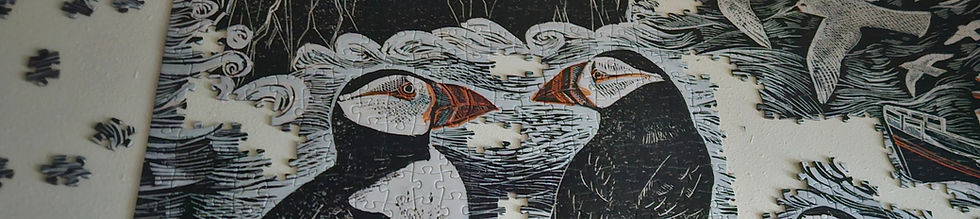
I started by taking several apps off my phone, including Facebook and YouTube. I also considered activities to put in place of scrolling and, among other things, I decided to start doing jigsaws. And so, finally, we get to puffins! Angela Harding’s “Fair Isle Puffins”. The jigsaw caught my attention in Waterstone’s. It was the first of several jigsaws I have now completed.
But why jigsaws? How do they fit in here? How do they help me?
They fit in because they help me interrupt an ingrained pattern. They help me to replace the mindless escape on my phone. Really? Well, yes!
Some of the artwork used for jigsaws is beautiful so the picture itself is a boost. Aesthetically pleasing. Like other good art, it captures my attention and imagination. As we can only put our attention on one thing at a time, that means my attention is NOT on my phone. NOT on those highly charged apps sucking the life out of me. I get a slower, non-digital supply of pleasure. I also get the satisfaction of a job well done – eventually.
Also, there is no preparation for the process. Too much preamble is likely to lead to me abandoning something. Removing obstacles is important to improve my success. All the pieces just tumble out of the box ready to go (OK, hands up, there was actually some preparation for me this time as the workbench I needed to use for it was covered in layers of crap – static build-up from months of hiding things in the spare room. I can’t be the only one… lol).
So, workbench sorted, I tipped out the 1000 pieces and started. The first sense of satisfaction and drip-feed feel-good came from finishing all the edges. That sense of accomplishment of getting the border complete. A clear outcome. Result! And that then laid the structure for the next stage in doing a jigsaw.
Deciding on a bit of a jigsaw strategy introduced a new focus and some creativity. I went with grouping colours together – orange bits for beaks and legs, pinks/purples for the foreground flowers. The patterns and textures next – line hatching for the top of the sky, the white criss-cross for the puffins’ bodies and wings.
I scanned the pieces and got a small feel-good fix each time I recognised one to group with others and then I slowly found pieces that fitted snugly together to gradually build the picture.
For me, now that I have recognised some traits of my brain type, I see that I have lived much of my life out of sync. Most work I have done over the years, certainly earlier in my working life, was office based, administrative, computer facing, sedentary, slow, individual. I work better reactive and connected, even with a bit of imposed pressure – a deadline or teaming up with someone.
External environments that don’t reflect my internal one tend to introduce friction, tension or stress and this promotes the dopamine chase. Jigsaws and other similar activities help me slow down and manage my avoidance or inactivity, and help me gradually regain my health.
When I worked in a building society, I remember sitting behind the till one Saturday morning, looking at a queue stretching out the door. After the initial shock, the line of customers actually sparked focus and there was suddenly no clock-watching or stress. Actually, no pressure at all despite being super busy. Similarly, as a housing officer many years ago, I did door-to-door rent collection (with one of the few councils to still do it at the time). A personal connection with tenants and enforced structure of the walk route made it pleasurable and not stressful work. Aspects of structure like this show up today in my counselling work.
Stopping phone use would be an obvious self-supporting thing for me to do, as it would likely be for others. Wouldn’t it? Easy hanging fruit if you like, but despite this, I still hadn’t picked it as something to change – I was managing it fine, I said to myself. “I can moderate my phone use well enough”. But that’s not true. I do need to stop. I do better with abstinence than moderation. So I need stricter boundaries around what I use my phone for and when. I am working on it but it’s a bit of a start-stop process just now.
It is a tough nut to crack. And phone use is so normalised nowadays. Opening a phone and starting to scroll is mesmerising. It’s as if persistent phone use creates a dopamine version of a morphine pump driver, endlessly topping up the pleasure. Looking back, I see I have always been a sucker for quick pleasure fixes over sustainable wellbeing. A process that accelerated with computers and even further with the smart phone.
I see in myself and others the well-trodden path that leads towards a “fried brain” – a brain adapted to constant easy stimulation, through multiple dopamine “fixes”. A brain whose neurology is doing its best to moderate and defend against so much of that neurotransmitter’s effects. On top of which, ADHD seems to come with a dopamine system that struggles in neurotypical surroundings and it adds a layer of challenge – addiction and ADHD often go hand in hand. Choosing repeated pleasure seeking in the moment over longer-term, healthier benefits. This can lead to a gradual, often imperceptible, decline in quality of life. A situation often put down to other factors.
Such addiction loops have been around in some form or another for centuries, but today, we have virtually unfettered access to stimulation on a mobile phone. Anywhere. Any time. Doomscrolling, gaming, gambling, porn. And this on top of “traditional” self-medicating habits of nicotine, alcohol, sugary food and casual sex, to name but a few. And very often, we enjoy a cocktail of several. How many do you have?
Remember too that the system (on smartphones) isn’t out to HELP you with this. Phone apps draw us in, always just a bit more enticing. Just like cigarette manufacturers added sugar and menthol to tobacco, on top of boosting sales through glamorous advertising where riding on horseback through Marlboro Country felt aspirational. So, we’re not just up against our own will. The system and app designers make it extra difficult for us – they want more money.
It is so easy to get caught up. Swept along. Dazzled by the dopamine rush. That feel-good buzz is all we need at the time. But it is spiky. Crashy. Empty. Down-regulating. There are diminishing returns for the time spent and potentially significant negative consequences in the medium to long term.
The thought of stopping these “little pleasures” on my phone seems overkill, but if I am to move forward, I need to do it. When I am sitting with a client, I don’t need my phone. It is switched off. My brain works just fine, thank you. It’s not permanently broken, and it’s not struggling in every area. It just needs a healthier environment. I need a healthier environment. And I need more appropriate things to focus on. And time to recover. I need to bring the pirate ship the Golden Rush into the harbour and step off on to solid ground.
I walked past a McDonald’s in Glasgow and at all the tables along the windows, individuals, couples and small groups, of all ages, were all glued to their phones. Every single one of them. There was no real connection to be seen. Parts of social media seem to be targeting people’s sense of self and dissolving it.
The pernicious disconnect of the digital age has an impact on how we are as people. How we feel. Who we love. How we love. How we handle setbacks and disappointments. How we process not getting our own way. Becoming offended by someone else’s opinion and assuming the right to attack. Blaming without a sense of responsibility. People’s mental health is being harmed. Relationship is being eroded. Big time!
So, what can be done? This isn’t an easy or a quick fix, so don’t get disheartened if your efforts stall. I think there are three things to think about first.
Start with awareness and honesty. We can’t change what we don’t see, so the clearer you see and understand how things work for you, the better. The body is built for balance and is constantly striving to achieve it. With smartphones, dopamine can easily become the main event and this causes an imbalance. There are many other ways to be happier.
Watch how often you open your phone. And be honest with yourself. This is your responsibility and your personal mission, should you choose to accept it. Nobody but you needs to know if you spend two, four or six hours a day on your phone. Notice what was happening for you just before you opened your phone for to watch reels or play on your bingo app? Or just before you signed in to Tinder, Grindr or PornHub.
Were you bored? Stressed? Angry? Mindless? Did you just respond to a message notification and then BAM! You’re back on your phone and an hour is lost.
Look at the other “feel-good” supports available to us all: oxytocin; serotonin; endorphins. These neurotransmitters are also available for everyone to improve their mental health and wellbeing. I’ll come back to these in another article but there’s plenty information about them online. In the meantime, if you rely on dopamine to do the heavy lifting, you will most likely meet a life characterised by increasing dissatisfaction.
Secondly, reduce access to other “cheap” dopamine fixes too – cut back on immediate pleasure or instant gratification. As with opening your phone, what was happening for you immediately before you bought the donut? Before you poured the next gin or glass of chilled sauvignon blanc? Before you ate the chocolate bar?
What would happen if you just didn’t do it this time? Replacing these with something else, at least some of the time, will help.
Start small. Swap some of your phone habits for puffins… or whatever other activity you find would work for you. Reading, sewing, crafting, forest walks. Think back to times past when you felt more relaxed. What did you do? Pottery? Photography? Baking? Watching movies. Board games. Watch a sunrise. Why not try cooking a meal from scratch. It may help to buddy up as well – this can really help if your willpower falters.
As with my client, look at introducing some sort of routine or setting some time limits. Allowing for the fact that it is hard. Self-discipline is necessary, and this can be a scarce resource. You still need to actually run the routine. Refresh your intent or commitment to this every day. Or every hour, or minute to minute if you need to!
You have to want a better quality of life enough to tackle these stubborn habits. Do you want it enough? It is worth emphasising, though, that you should expect relapses. It takes time to move the needle here.
Thirdly, you can also think about speaking to a therapist like me to consider the wider emotional friction that could be behind some of your lifestyle habits. Exploring the context of how this all developed is often fundamental to building sustainable change. Consider how well aligned your internal and external environments are. Personal work will help with how you see yourself and others and build your tolerance for discomfort and emotional availability and boost your mental health and wellbeing in other ways.
Conclusions
So, have the puffins fixed everything? Well, no, not entirely. That’s too much to ask of the little pelagic seabirds. However, the process of recognising that I have been fast and loose with dopamine has been important for me. This precious resource is essential for feeling good, getting things done and for my general wellbeing but the system is out of whack.
I continue to do jigsaws, and this is helping. But I didn’t take Instagram off my phone, and though it wasn’t a big contender previously, I can now easily dive in and get lost. I am still resisting.
Some days I can leave the flat early, without my phone and do a long walk along the River Clyde and back into the city centre where I sit in a favourite café and write. I manage fine without scrolling.
There is still work to be done… and I am persevering. I am gradually managing my dopamine system better so I can more easily manage my discomfort and need to avoid boredom better. And I am continuing to adapt my external environment to reflect how I operate best on the inside.
I will add though that this is a challenge beyond the individual. I think we all have a responsibility to pay more attention to online stimulation at the cost of human connection. Parents, teachers, influencers, peers and pals as well us ourselves. Step forward and engage with others more often. And make it more ok that sometimes it is good to just sit quietly.
What can you do? Do you want to try a phone-ban routine? No phones at dinner. Don’t touch your phone before 9am or after 9pm. Can you replace scrolling with a hobby or pastime or a movie? Do a crossword or Sudoku in the coffee shop. What about a catch-up phone call or a visit to a friend for a cuppa, taking a lemon drizzle cake?
Try something and see what happens. Lead the way among your friends and family. If you are a self-starter, and this sort of thing is easier for you, reach out and boost someone who isn’t. They will repay you elsewhere.
Apart from anything else, you will see things improve for you!

Comments